ABOUT THE 6 MARKERS OF CLIMATE EMERGENCY
The Climate Emergency Unit’s final 12-minute video on the 6 Markers of Emergency.
How do we know when a government is in emergency mode?
When they act like it.
Adopted from Seth Klein’s book, A Good War: Mobilizing Canada for the Climate Emergency, we’ve developed a framework to determine whether governments or large institutions are in genuine emergency mode.
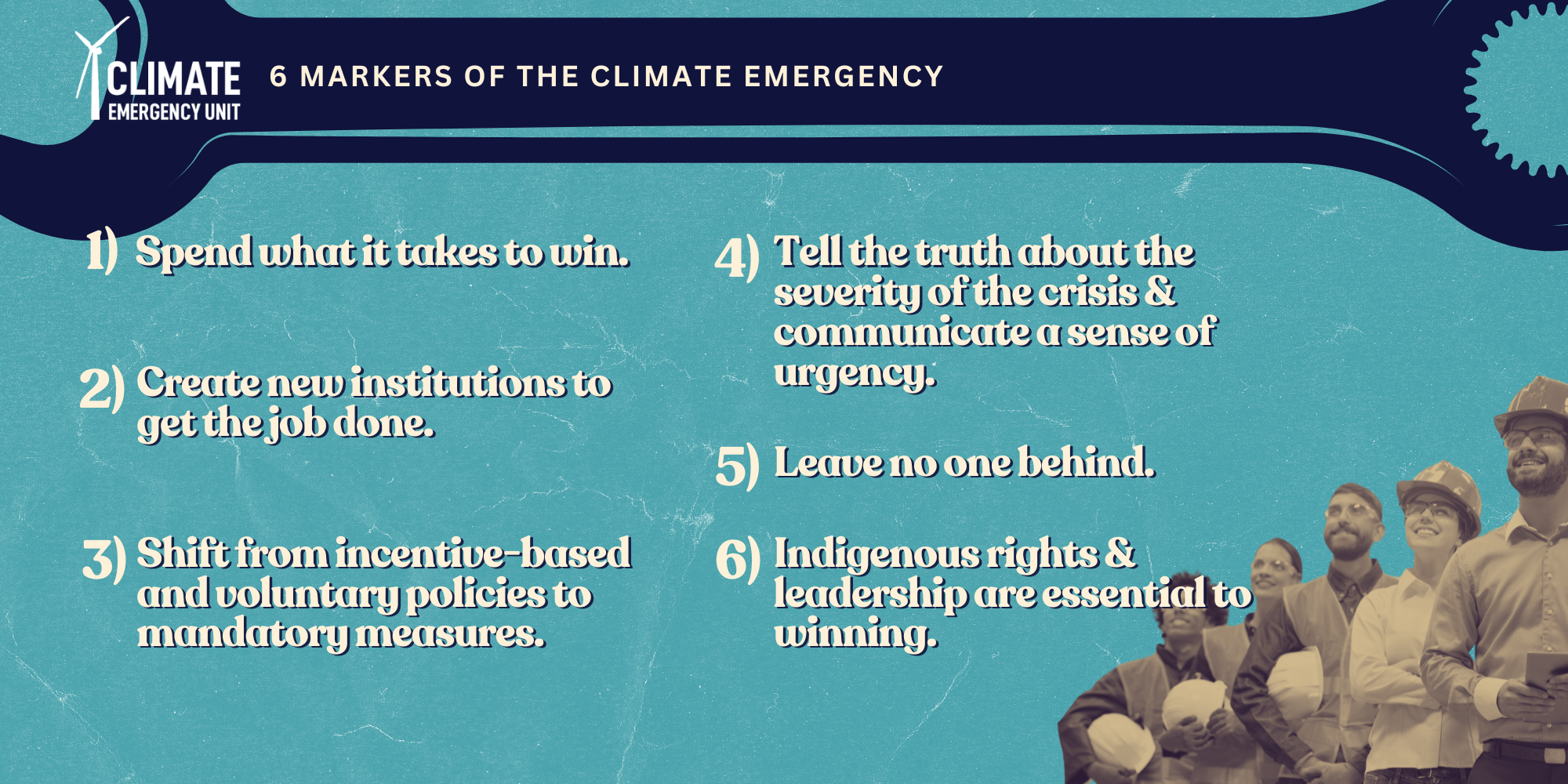
About the 6 Markers of Climate Emergency
We believe that it’s not too late to change the course of the climate emergency and prevent more catastrophic suffering. But to do this, we need the kind of transformational change not seen since the Second World War.
We got a glimpse into emergency mode during the first year of the COVID-19 pandemic, but the government failed to sufficiently hit Marker 5 (leave no one behind.)
As explained in Seth’s book, the Canadian government took extraordinary measures during the Second World War to ensure that it successfully navigated and confronted the rise of fascism. During the war, the government hit Markers 1 through 4 big time, and partially hit Marker 5.
These war-time measures worked once, and can be used again to fight the most dangerous threat we have ever faced: the climate crisis. But, it can’t be overstated how important it is to expand on the war-time measures of WWII to empower historically excluded populations of today and nurture a more just society for our future generations.
When asking people to enlist in a grand societal undertaking, we have to make a commitment to them that the society that will emerge from the other end of that effort will be more just and fair than the one they are leaving behind.
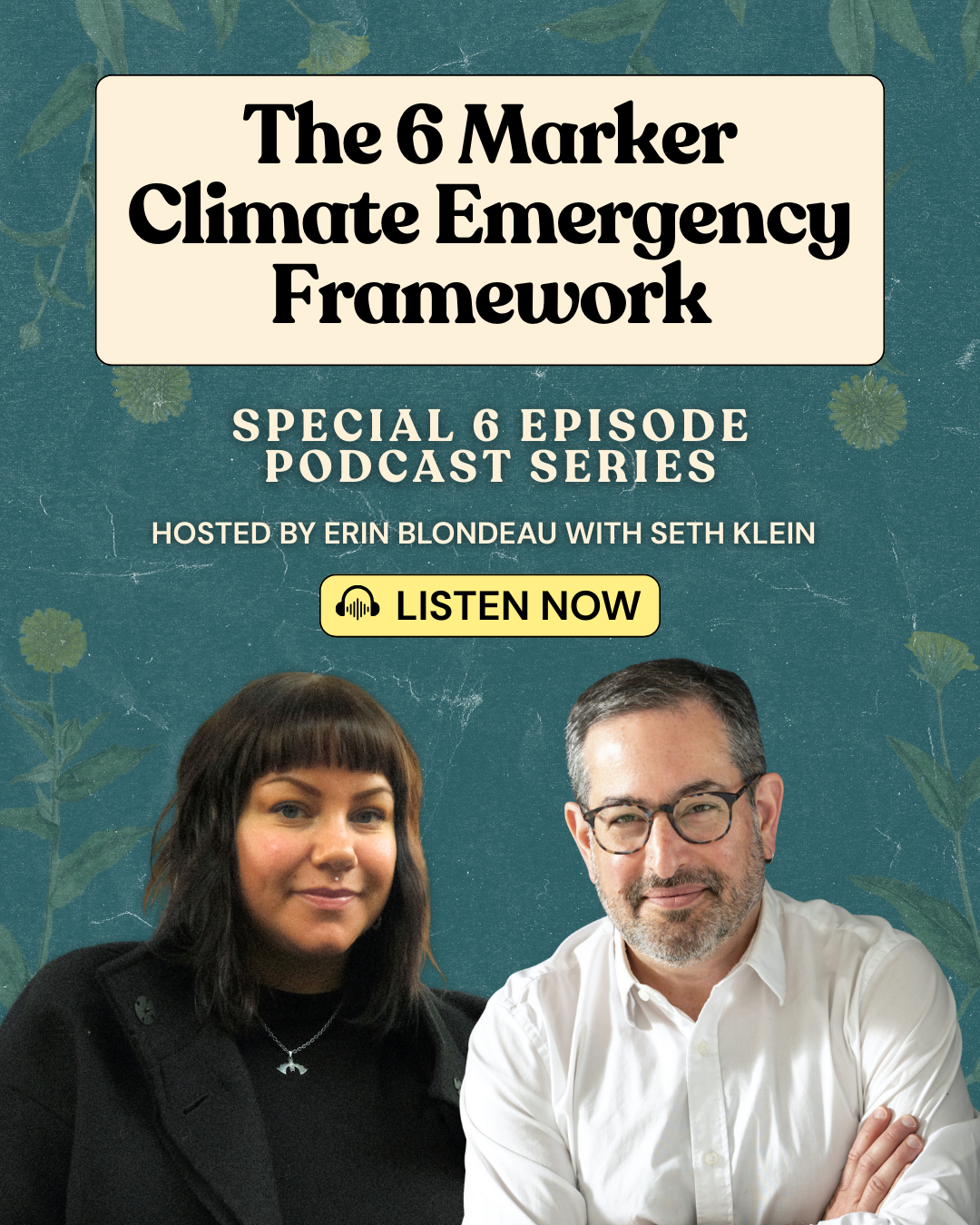
SPECIAL SERIES
Listen to the Climate Emergency Unit’s special 6-part podcast series on the 6 Markers of Climate Emergency Framework, featuring a line-up of stellar guests.
📲 LISTEN NOW
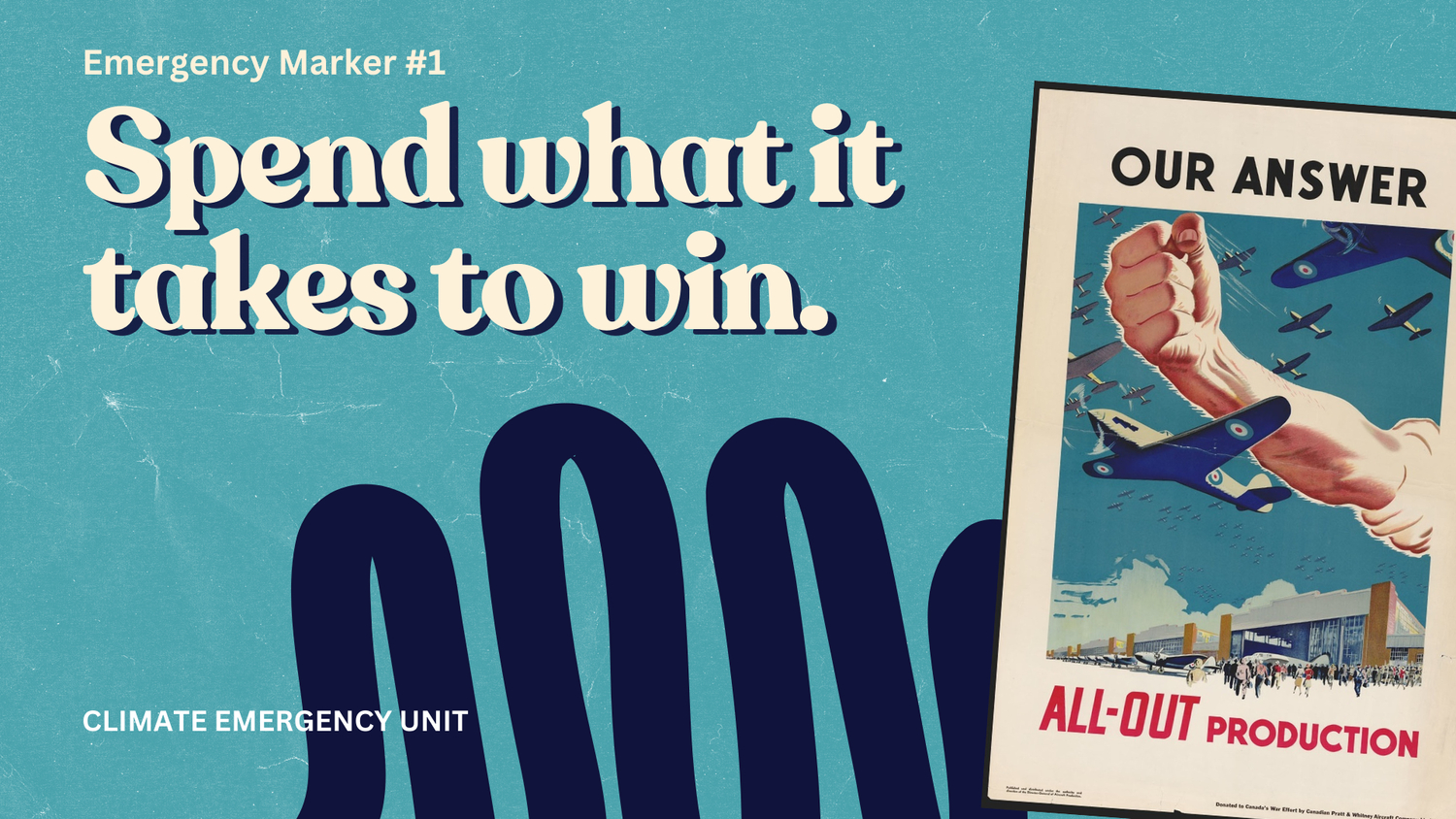
Marker 1: Spend what it takes to win
-
This marker asks a fundamental question: is the government willing and ready to budget and spend what's truly necessary to achieve our climate targets? Governments historically found the resources needed during genuine emergencies like the Second World War. We must do the same with the climate emergency.
-
Spending What it Takes: Transformational climate investments for long-term prosperity in Canada - CAN-Rac
Why aren’t we talking about war taxes? - Seth Klein (video)
Why aren’t we talking about war taxes? - Seth Klein
There’s always money for the military. But climate? - Seth Klein (video)
There’s always money for the military. But climate? - Seth Klein
Canada’s Fossil Fuel Funding in 2024 - Environmental Defence
-
Marker 2: Create new institutions to get the job done
-
To reduce carbon emissions, we need new infrastructure like renewable energy solutions, efficient and accessible transportation, and zero carbon buildings. We need new public corporations and federal programs that will mass produce and deploy the items needed to decarbonize and electrify our society.
-
Canada Needs a Youth Climate Corps - Climate Emergency Unit (video)
Learn more about the Youth Climate Corps campaign
The Sport and Prey of Capitalists - Linda McQuaig
Breaking Free of Neoliberalism: Canada’s Challenge - Alex Himelfarb
Why Canada's response to Trump's threats requires imagination and audacity - Seth Klein
Crises are no time for timidity: Response to Trump’s economic attack requires imagination and audacity - Seth Klein
If Carney wants to build, he should go big on a Youth Climate Corps - Seth Klein
-
Marker 3: Shift from voluntary & incentive-based policies to mandatory measures
-
We cannot beat the climate emergency with incrementalism and we cannot incentivize our way to victory. Will the government implement policies that require Big Oil and other major greenhouse gas emitters to reduce their emissions? Will they set clear and strong regulations that ban fossil fuels from our buildings and vehicles on a timeline that aligns with the emergency?
-
Vancouver City Council & the fight to prohibit natural gas: A win for climate action! - Seth Klein
Vancouver council's gas plan goes up in smoke after fierce public pushback - Seth Klein
Fossil Fuel Ads Make Us Sick - CAPE campaign to ban fossil fuel ads
Reflections on mandates, from COVID to climate - Seth Klein
Like we did for tobacco, we must ban false fossil fuel ads - Seth Klein
Plugged in or left behind? - Chris Hatch column on zero-emission vehicle mandates
Axing the EVs: Canadian sales plunge while global sales surge - Barry Saxifrage column on the power of vehicle mandates
-
Marker 4: Tell the truth about the severity of the crisis & communicate urgency
-
Climate scientists have been unequivocal in the IPCC reports. Now we must hold our government to the same standard. Is the government ready to communicate to Canadians, clearly and consistently, that we face an emergency? And is it ready to say a firm 'no' to new fossil fuel extraction and infrastructure projects that the International Energy Agency and IPCC have declared incompatible with a livable future?
-
Zero Carbon - Weekly climate newsletter by Chris Hatch
Dissecting the climate denial machine: culture wars and the climate countermovement - Break in Case of Emergency
Mapping right-wing activism, corporate lobbying and climate denialism - Break in Case of Emergency
Fossil Fuel Ads Make Us Sick - CAPE campaign
Quiet Alarm: A Review of the CBC’s Climate Reporting - Report led by SFU's Community-Engaged Research Initiative (CERi) and CEU
CBC must strengthen its case on climate for our (and its own) survival - Seth Klein (video)
CBC must strengthen its case on climate for our (and its own) survival - Seth Klein (column)
Crisis, what crisis? We need a climate emergency information agency - Seth Klein
Is Suzuki right that it's 'too late'? We are in an era of simultaneous wins and losses - Seth Klein
The climate movement must shift gears or it's done - Seth Klein
What do Canadians really think about climate change?: A summary of public opinion research for communicators - Re.Climate
-
Marker 5: Leave no one behind
-
A society-wide mobilization requires social solidarity, and inequality is toxic to solidarity. The government must make a hopeful, compelling offer to those whose economic security feels tied to fossil fuels. How will it ensure fair treatment and opportunities for all as we undertake this transition? What supports will be in place for lower-income households, for fossil fuel workers, and for Indigenous communities on the front-lines of extraction? And will Big Oil and the wealthy be made to pay their fair share?
-
The Fair Shares campaign website: www.climatefairshare.ca
Support the Fair Shares platform 350.org/canada/fairshare
Centre for Future Work website: centreforfuturework.ca
The G7 and Canada’s climate fair share - Break in Case of Emergency
Enormous Jobs Potential from Energy Transition Investments - Jim Stanford
Why tackling climate and inequality must go hand-in-hand - Seth Klein
Testimony to the House of Commons Finance Committee about the need for a Just Transition Transfer - Seth Klein
Why aren’t we talking about war taxes? - Seth Klein (video)
-
Marker 6: Indigenous rights & leadership are essential to winning
-
How will the government uplift Indigenous sovereignty and rights, including land rights, title, and the right to deny pipeline expansion and industry land grabs? How will it honour the United Nations Declaration on the Rights of Indigenous Peoples (UNDRIP) in the face of fossil fuel projects? And how will it support Indigenous communities in achieving energy and food independence, free of fossil fuels?
-
‘Economic reconciliation’ is a false promise for Indigenous peoples - Janelle Lapointe
Canada’s new fast-track laws double down on false promise of ‘economic reconciliation’ - Janelle Lapointe
Sacred Earth website: www.sacredearth.solar
Yellowhead Institute website: yellowheadinstitute.org
Why Ksi Lisims LNG Must Be Stopped - Seth Klein (video)
The next big LNG proposal - Ksi Lisims - may be the sleeper climate issue of 2024 - Seth Klein
Indigenous Resistance Against Carbon - Report by Indigenous Environmental Network & Oil Change International on how Indigenous resistance disrupts billions of tons of greenhouse gas emissions annually
YCC Indigenous webinar
-